MEZUZAH
WARSZAWA
WALICÓW 14

$248.00

The idea:

Bronze Mezuzah from Warsaw. This mezuzah is a bronze cast of imprint of the mezuzah trace found at the old tenement at Walicow Street in Warsaw. We created a new mezuzah out of bronze to make the history tangible. Touching the mezuzah activates a link between past and present. MI POLIN – contemporary judaica brand from Poland.

Size

4,33” long / 1,18” wide

Material

Bronze

SET & PRICE

The given price is the final product price for a set consisting: product and a dedicated to this product e-booklet.

TAX

In exceptional circumstances, a customs duty of $10 – $20 may apply. The change is due to US administration policy. Applies to shipments to the USA.

SHIPPING

Fare starts form 48$ to USA and to most countries outside EU. We ship by UPS. 

Production

All components, prints, raw materials and finished products were manufactured 100% in Poland.

Shipping info Worldwide UPS shipping rates starts:
Poland – always 5,5$
USA & CANADA - from $40
UE & UK - 22$
THE WORLD – 55$

Description

Discover the jewish history story behind the Mezuzah from Warsaw 14 Walicow Street“Mezuzah from This Home” heritage judaica collection

Mezuzah trace availability status: Inaccessible to visitors (building permanently closed; severe structural collapse hazard)

bronze cast of the mezuzah trace found in Warszawa at 14 Waliców Street.

Brass mezuzah case cast from an authentic pre-war mezuzah trace by MI POLIN Judaica featuring raw textured metal finish. Jewish design made in Poland. the former Jewish quarter in Warszawa, Poland at 14 Waliców Street. Before World War II, this area was the site of the Jewish ghetto.
Close-up detail of the handcrafted solid bronze mezuzah cast from an original pre-war Jewish mezuzah trace found at Walicow 14 Street in Warsaw
Side profile of the solid bronze mezuzah from Walicow 14 Street in Warsaw, preserving the Jewish history of the Warsaw Ghetto

Władysław Szlengel

Many distinguished persons lived in the tenement house at 14, Waliców St in Warsaw before WW II . One of them was Dawid Szulman, a lawyer who during the war was a member of the Jewish Military Union. As a lawyer he judged traitors and Jewish members of Gestapo – SS and Wehrmacht collaborators. Together with Berł Braudo and Sara Granatsztejn he executed a death penalty on the director of the Judenrat economic department, Izrael Firszt, for collaborating with the Germans. All three of them were killed in the Holocaust.

Władysław Szlengel (1912–1943) was a Polish-Jewish poet, journalist and songwriter who lived at 14 Waliców Street in Warsaw, a historic tenement house that later became part of the Warsaw Ghetto. Known as the Poet of the Warsaw Ghetto, Szlengel documented the tragic reality of Jewish life under Nazi German occupation through powerful poems and literary works. His writing captured the fear, suffering, everyday struggles and destruction of the Jewish community in Warsaw during the Holocaust. Today, his connection to Waliców 14 makes this historic building an important place of memory, linking the history of a Jewish home with one of the most significant literary voices of the Warsaw Ghetto.

Aerial view of the surviving pre-war Jewish tenement building at Walicow 14 Street surrounded by modern Warsaw skyscrapers
Overhead aerial photograph of Walicow Street in Warsaw showing the historic tenement at number 14 where Polish Jews lived before the Holocaust
• War-damaged brick facade and window openings of the historic Jewish tenement at Walicow 14 Street in Warsaw

German attack against warsaw uprising

During the Warsaw Uprising Waliców St. was the area for fighting battles by the Home Army “Sowiński” battalion. A participant of these battles, Jerzy Woźniak “Szpila” reported: “On 24th September the German infantry, supported by two tanks, attacked our positions at Waliców St in Warsaw. The attack was preceded by the explosion of a huge bomb, that destroyed the façade of the building at 14, Waliców St. After heavy fighting, the attack was repulsed.”

• Historic ruins and shell-damaged walls at Walicow 14 in Warsaw, site of heavy battles during the 1944 Warsaw Uprising
Abandoned interior and decaying stairwell inside the pre-war tenement house at Walicow 14 Street in Warsaw
Vertical architectural view of the surviving pre-war tenement wall at Walicow 14 Street in Warsaw
• War-damaged brick facade and window openings of the historic Jewish tenement at Walicow 14 Street in Warsaw

Jewish Warsaw Historical tenement to 1945

No proprietary claims regarding the building have ever been filed. The tenement house was partially inhabited until the year 2000. In 2015 the city authorities issued the order for the house to be demolished. The order was suspended after intervention from the local authorities. In 2017 a group of municipal activists applied to the conservator – restorer to register the house at 14, Waliców St in the Polish National Registry of Historic Buildings. It is one of the very few tenement houses from the former ghetto area that survived to this very day, bearing witness to the history of Warsaw.

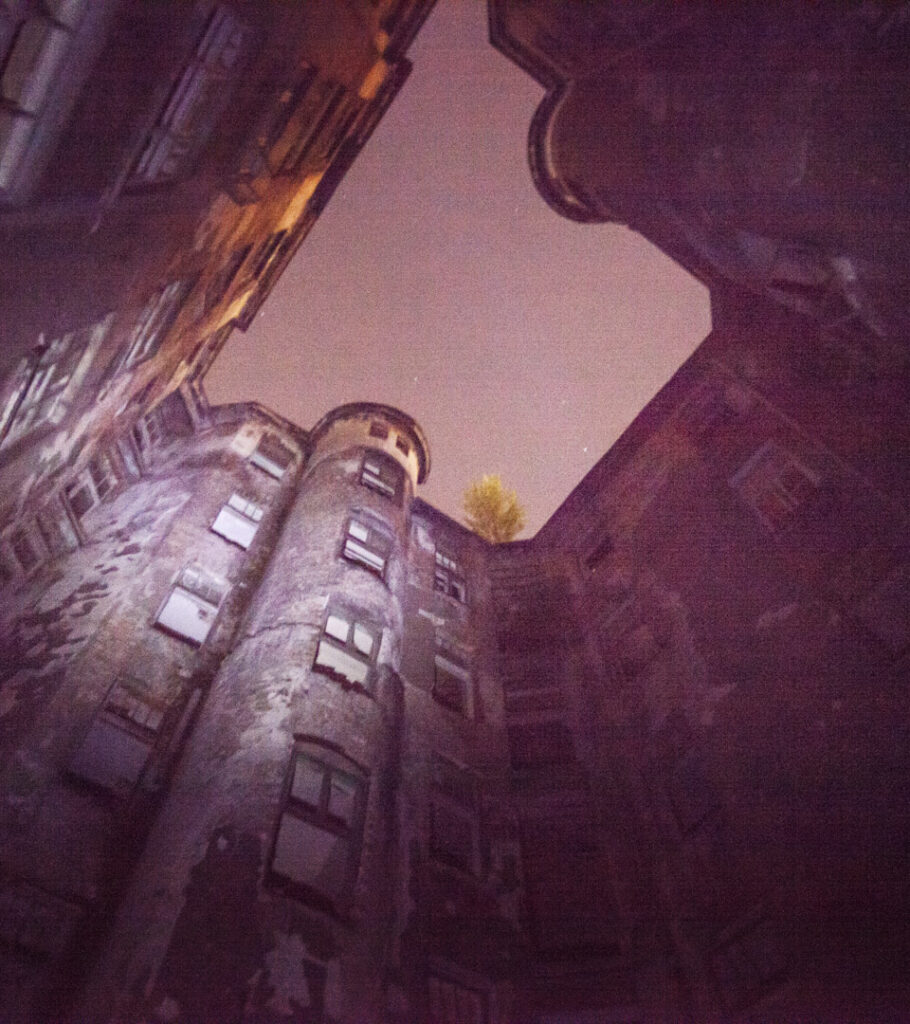
Upward low-angle view from inside the inner courtyard well of the historic ruined tenement at Walicow 14 in Warsaw, showing weathered brick walls, rounded staircase tower, empty windows, and a tree growing on the roofline against the night sky

Bullet-Scarred Witness Amid Glass Skyscrapers: Waliców 14 After 1945

Following World War II, the heavily damaged front wing of the tenement—destroyed by a German Goliath tracked mine and fire during the 1944 Warsaw Uprising—was never rebuilt. Under the communist regime of the Polish People’s Republic (PRL), the property passed into state and municipal ownership; no proprietary restitution claims regarding the building have ever been filed. The surviving rear wings surrounding the two courtyards were patched up and converted into municipal social housing (mieszkania kwaterunkowe), remaining continuously inhabited by working-class families until 2004, when the last tenants and ground-floor workshops were relocated due to the building’s deteriorating structural state. Left vacant and unrenovated for decades while glass skyscrapers transformed Warsaw’s Wola district around it, the bullet-scarred brick ruin became an iconic symbol of Warsaw’s vanishing memory—highlighted in May 2009 by a famous street-art mural on its Grzybowska-facing gable wall depicting a glossy red balloon and the poignant question “Kamień i co?” (“Stone, and what next?”). In August 2015, the District Building Supervision Inspectorate declared the structure beyond repair and issued an official demolition order. The order was suspended following intense intervention by local Wola district authorities, urban heritage activists, and international scholars (including the 2016 Waliców Project by Milan Polytechnic architects). In 2017, civic activists formally petitioned the conservator to protect the site, leading to its official listing in the Polish National Registry of Historic Monuments in 2018 and subsequent emergency roof and wall stabilization. Today, Waliców 14 stands as one of the very few surviving tenement houses from the former Warsaw Ghetto area—an irreplaceable, unpolished witness to pre-war Jewish life, the Holocaust, the Warsaw Uprising, and postwar Warsaw.
Close-up of the faint, hard-to-find pre-war mezuzah trace discovered on a weathered doorframe inside Walicow 14 in Warsaw
MI POLIN co-founder Helena Czernek searching for pre-war mezuzah traces inside the ruined tenement at Walicow 14 in Warsaw
• Field documentation by MI POLIN inside the historic Warsaw Ghetto building at Walicow 14 Street, preserving Polish Jewish heritage
WARSAW HELENA CZERNEK MI POLIN MEZUZAH TRACE WALICOW
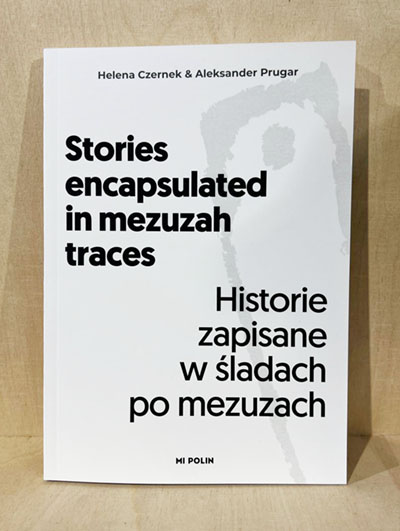
Designed by Helena Czernek and Aleksander Prugar, founders of MI POLIN and the world’s first mezuzah trace museum (MI POLIN Mezuzah Center in Warsaw)Who is mI POLIN?

You may also like…
Go back