
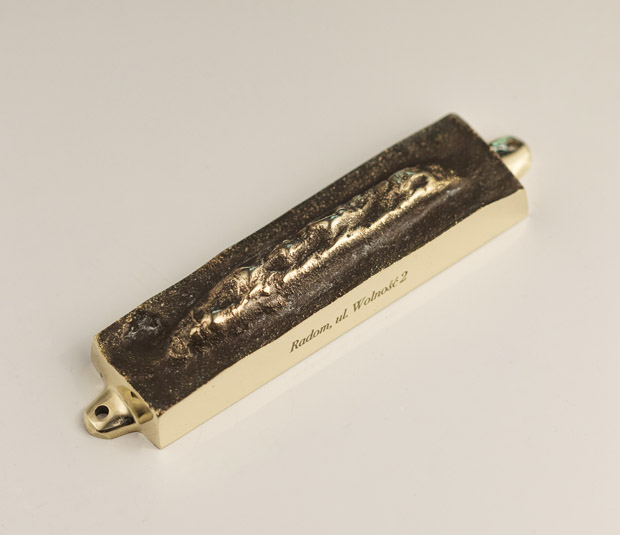
MEZUZAH
RADOM
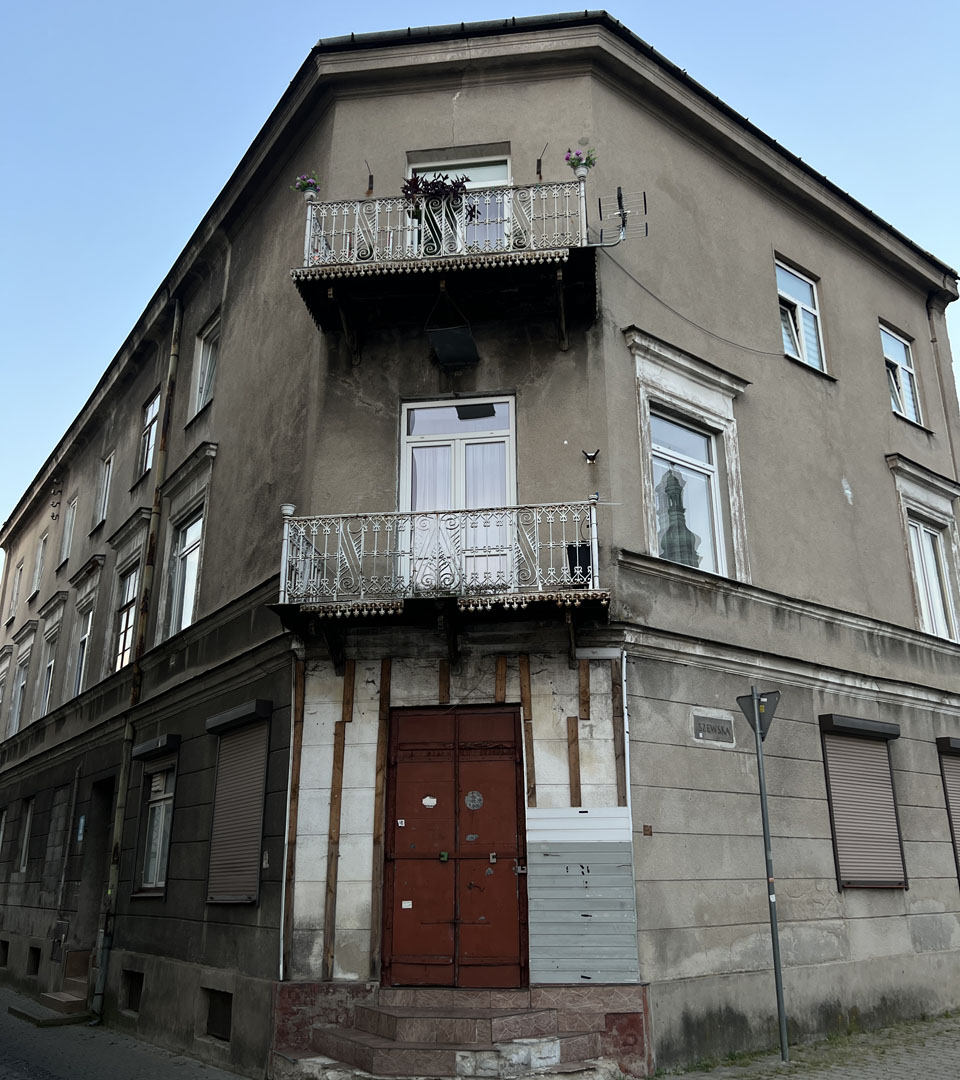
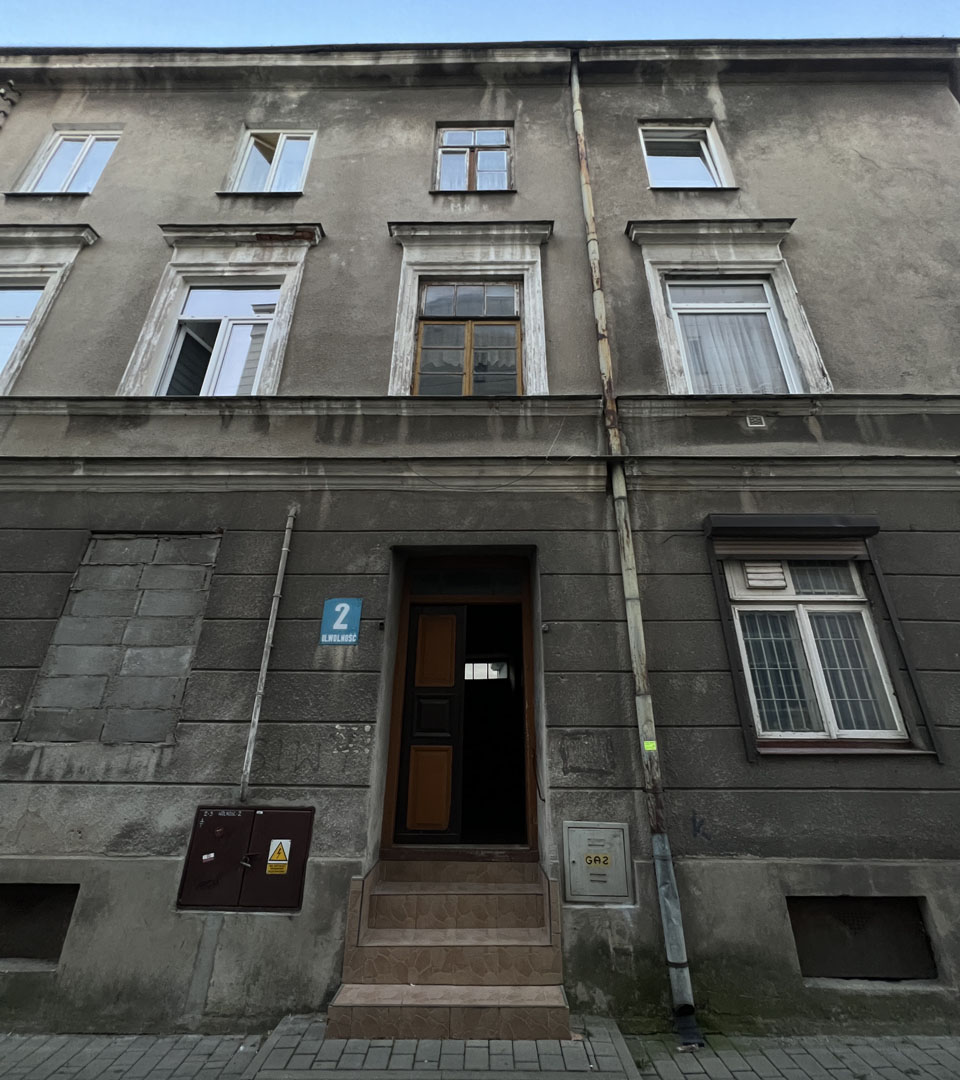
WOLNOŚĆ 2
$248.00
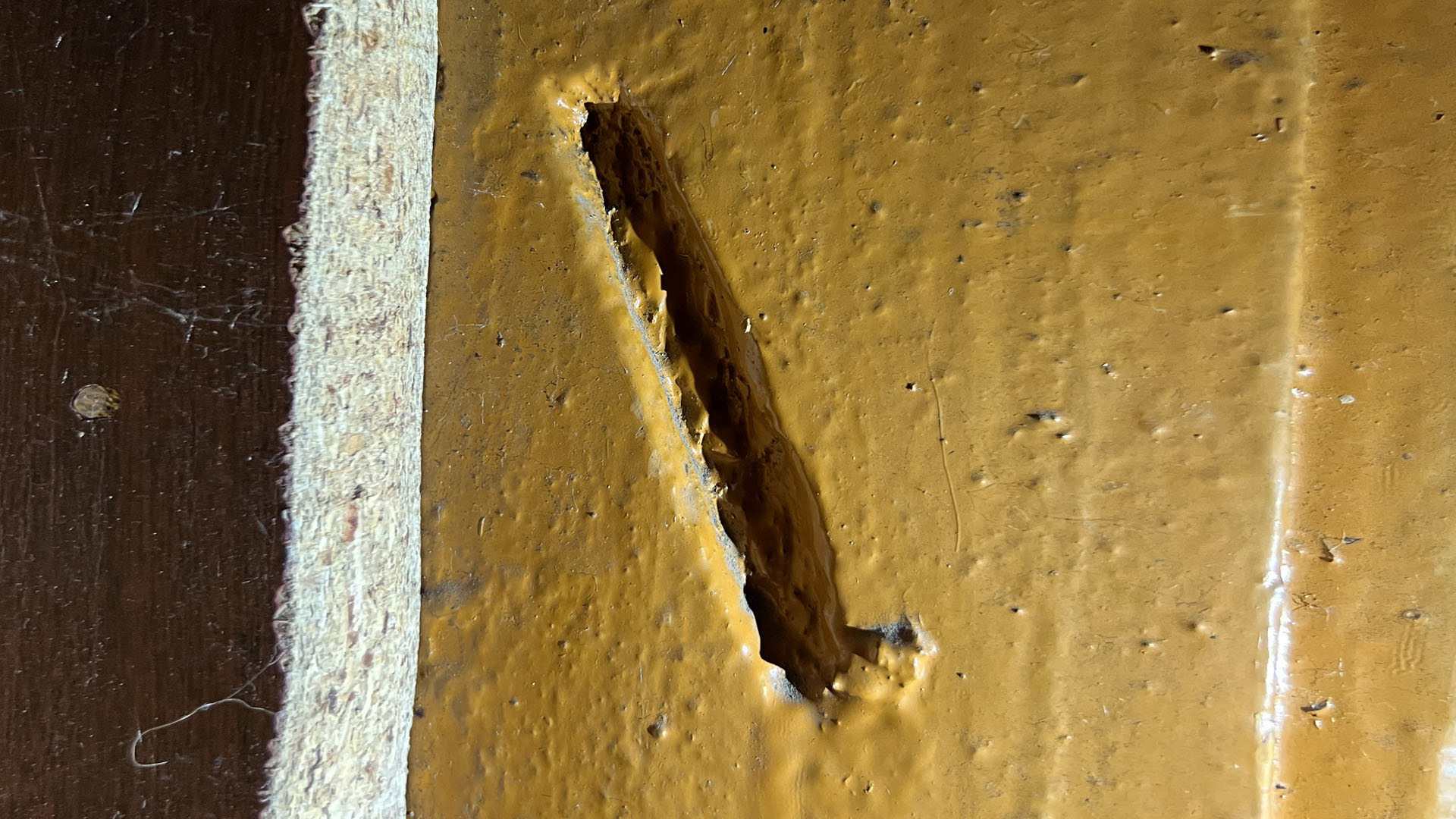
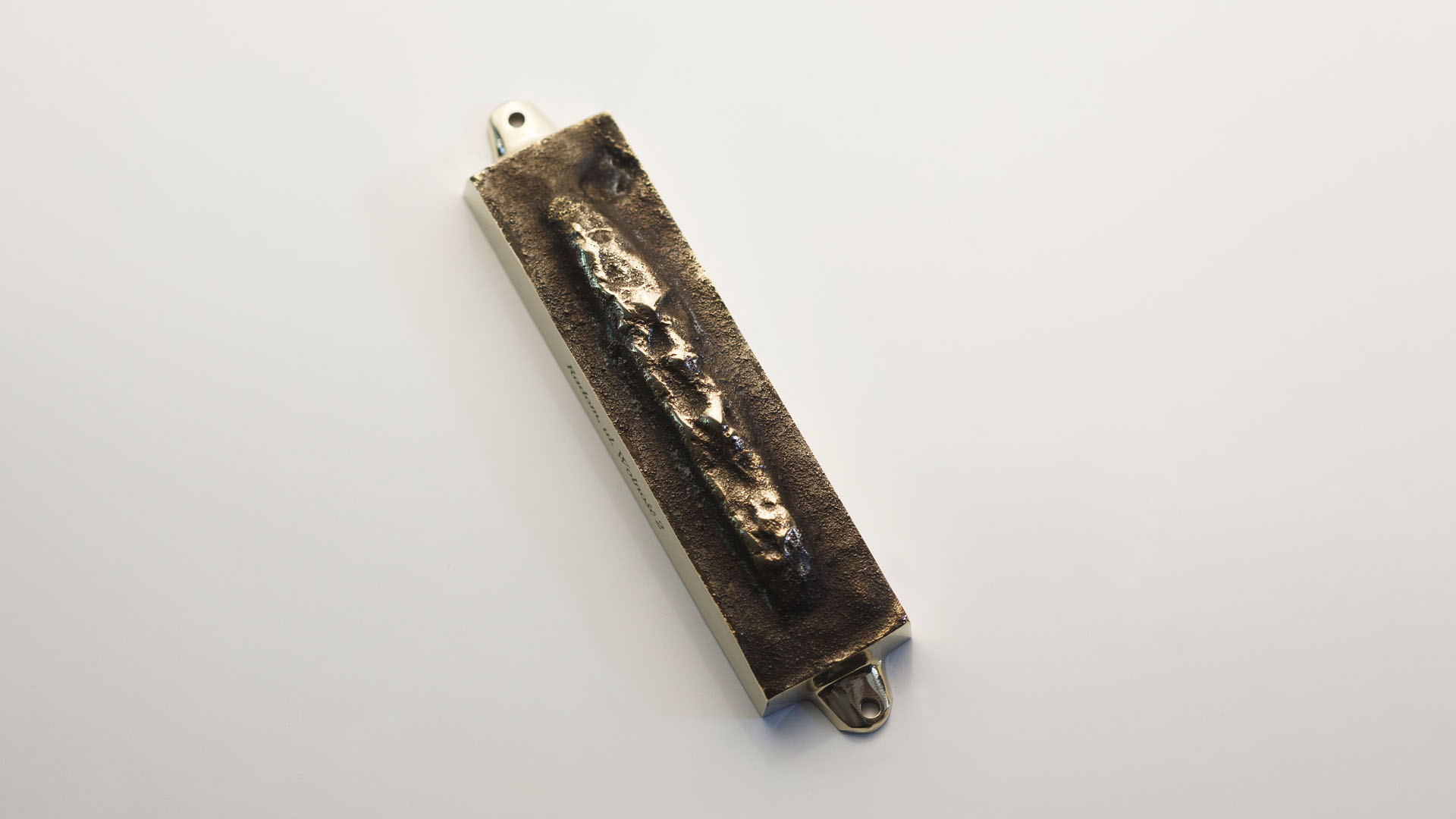
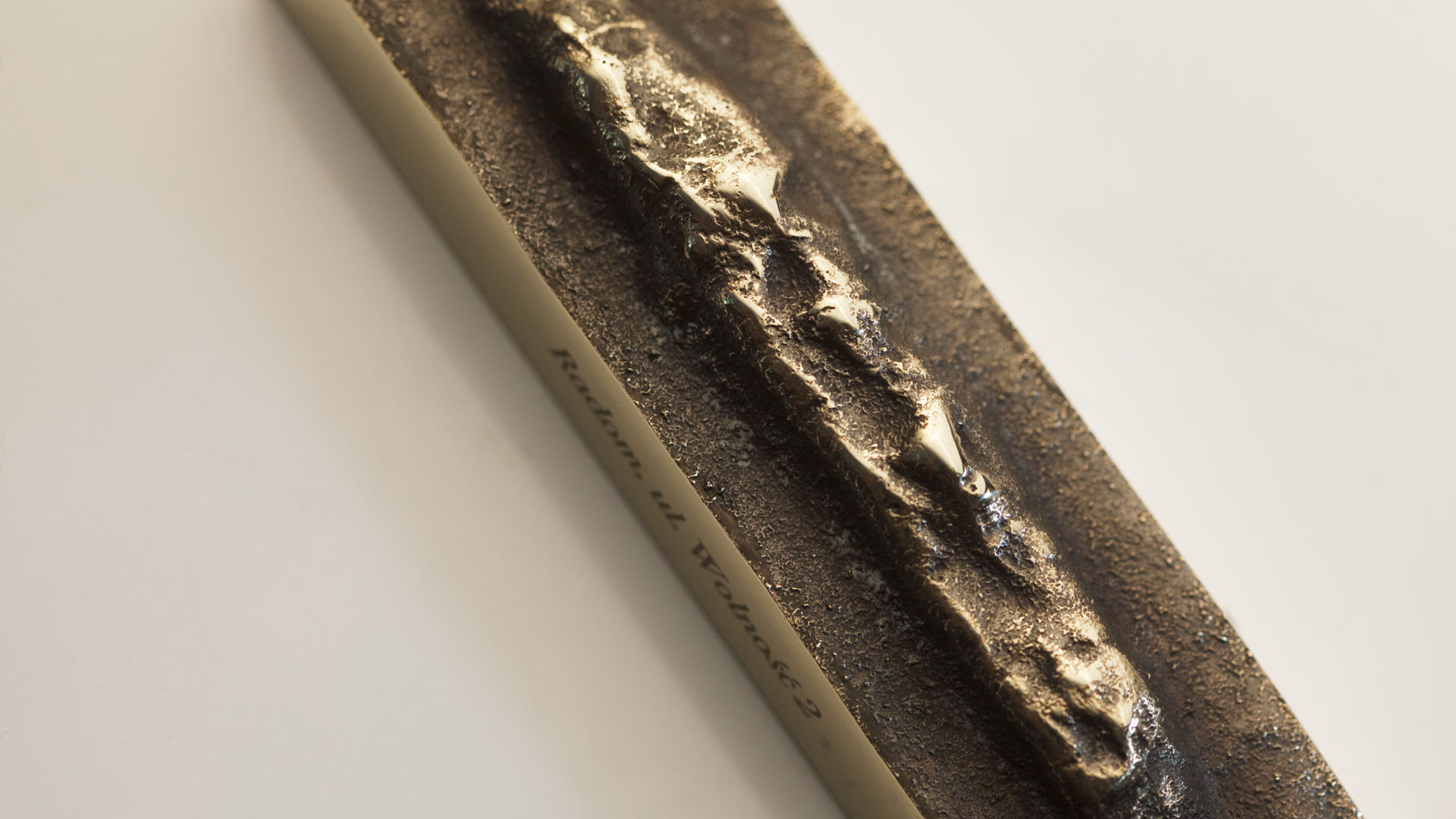
| The Idea | Bronze Mezuzah from Radom. This mezuzah is a bronze cast of imprint of the mezuzah trace found at the old tenement at Wolność 2 Street in Radom. We created a new mezuzah out of bronze to make the history tangible. Touching the mezuzah activates a link between past and present. MI POLIN – contemporary judaica brand from Poland. |
|---|---|
| Size | 4,33” long / 2” wide |
| Material | Bronze |
| SET & PRICE | The given price is the final product price for a set consisting: product and a dedicated to this product e-booklet. |
| TAX | According to the latest August 2025 US customs tariffs, our products are exempt from duties and taxes. In exceptional circumstances, a customs duty of $5 may apply (for large orders). |
| SHIPPING | Fare starts form 48$ to USA and to most countries outside EU. We ship by UPS. |
| Production | All components, prints, raw materials and finished products were manufactured 100% in Poland. |
Description
The trace of mezuzah
new mezuzah - bronze cast of the trace
The story hidden behind

the home
The property at 2 Wolność Street belonged to a Jew born in Kozienice on February 13, 1877. Mojżesz, aka Moszek Elia Lastman, one of seven children of Szmul Izrael Chaim Lastman and Gołda Jungman. His wife was Chaja Cukier.


the family
Among their eleven children we can mention – apart from Ita and Abram, who died young – sons Icek Lejb Lastman (born December 22, 1898; at the age of nineteen he married Sura Cymla Wajsbort, born the same year, with whom they had six children, most of whom survived the war), Chaim Lastman (born April 30, 1911), Josek Lastman (born 1915), Gerszon Lastman (born January 3, 1916), Rywen Lastman and daughters Tauba Hochberg (Towa, born 1901, married Lejbuś Hochberg, with whom she had at least four children), Róża Libhaber (Rajzla, born 1903, married Mosze Libhaber, who died before the war), Chana Rapoport (born January 18, 1906, married Josek Rapoport [Lejzor Rapaporta?] and they also lived in the family tenement house at Wolność 2) and Luba Goldberg (born 1920/1921, married Josek Goldberg). The circumstances of the latter’s death are described in her memoirs by another former resident of this tenement house, Millie Werber, who describes the murderous march from Radom to Tomaszów with the destination station at Auschwitz:
“I saw my friend, Luba Lastman, run into a field of tall wheat; I think she was hoping to escape. Luba was the daughter of the owners of the tenement building on Wolności Street, where we lived. Around twenty years old, young and strong, she probably thought she would be faster than the soldiers. However, the Germans ran after her with dogs, sniffing, barking, racing on taut leashes. I heard a shot from a short distance away.”
The granddaughters of tenement owner Moszek Lastman certainly survived the war: Antonina (Towa) “Tosia” Goldberg, née Lastman (born October 3, 1926, who endured seven camps, including Majdanek, Płaszów, and Auschwitz) and Ita Cukier, née Hochberg (born 1918). “Lola” Łaja Lastman also survived.
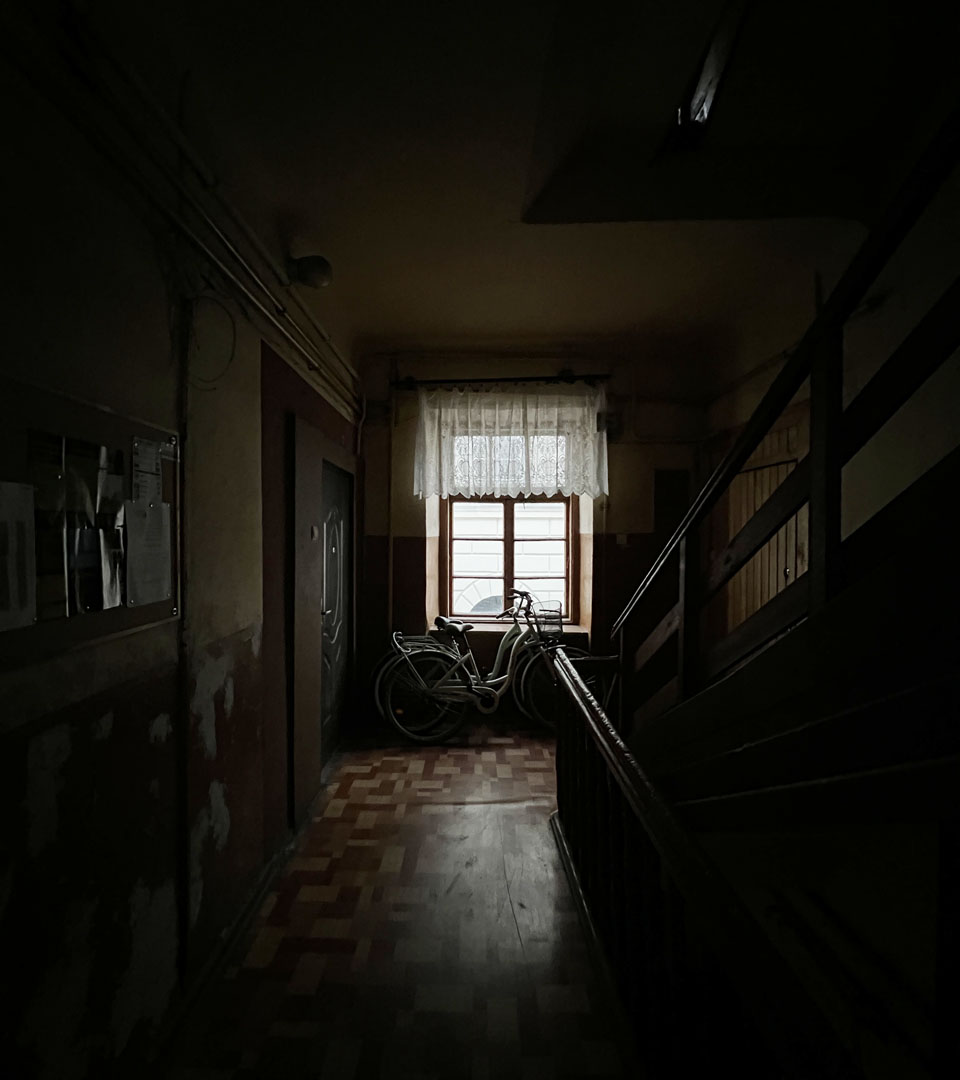
Another resident of the tenement building at 2 Wolność Street, Małka “Mania” Drezner, later known in America as Millie Werber, also survived thanks to forced labor for the Germans in a Radom arms factory. She was the author of the tragic memoir “Two Wedding Rings: A Story of Love and War,” thanks to which we know a lot about her family and the tenement building’s inhabitants before the war. Mania was then “a girl with pigtails […] I was young, thin, and petite, but clearly in good health.” “I was twelve or thirteen years old, sometimes I would sneak out into the courtyard of our tenement building […] and sit in the corner with friends, boys and girls, to play cards with phrases printed on them like: ‘I like you,’ ‘I’d like to go to school with you,’ ‘You have a beautiful dress.’ We would pass these cards from hand to hand, giggling and embarrassed. It was an innocent, slightly frivolous game; we had a great time playing it.” All I knew about boys and girls was what I learned from playing cards in the yard. It seemed pretty exciting. […] I thought if I touched a boy, I’d get pregnant.”
Mania lived with her older brother Majer Drezner (who, although “he studied at a private Jewish high school, which was a great honor in those days,” after the outbreak of the war worked as an ordinary street sweeper) and, above all, with her mother – Dwojra Drezner née Ajchenbaum (born May 30, 1895, daughter of Aron and Bina), a seamstress whose husband was often absent from the family’s life (“for the first seven years of my life, my father lived in Paris – I think he thought it was easier to earn a living there than in Poland […] he probably sent us, I think, a little money, and from time to time some treats – for example, cans of pineapple, slices of which I greedily devoured between slices of cornbread with butter”; “I once saw my mother reading a letter from my father. She was sitting on our bed behind the wardrobes with a piece of paper spread out in her hands and was crying quietly, quietly. I hated it, I couldn’t “I couldn’t bear those tears. And I hated seeing how hard he had to work when his father was gone”; he returned in 1935, but “in 1940 […] he left for Jedlińsk, a small village nearly 15 km from Radom. I knew our relatives lived there, but it wasn’t entirely clear to me why my father had fled there. […] My mother explained to me the reasons for my father’s departure rather vaguely, and I didn’t understand a thing. It had something to do with fear of arrest, but I had no idea why anyone would want to arrest my father. Perhaps I didn’t know him very well – after his return from a long stay in Paris, I never managed to establish a close bond with him”). The author, however, dedicates the most warm words to her mother: “She always worked. That’s how I remember her – Mom at the tailor’s table, cutting fabric without a pattern, sewing individual garments together, creating miracles from scraps of fabric. […] The rustle of dark fabric being moved across the table, the dust of chalk used to mark lines in the air, the girls working in focused silence. It’s a mystery to me […] how Mom manages to transform lifeless rolls of fabric into clothes so desired by her customers. And what beautiful clothes! Dresses, blouses, and skirts, all simple yet elegant. Ladies from the city come here, Jewish, of course, but also Gentiles, in fur-trimmed coats and carrying leather handbags.” It is from this book that we learn about life inside the tenement house: “Mom and I slept in one bed. Before moving to the ghetto, we lived in a large apartment, consisting of a room with a kitchen, in the center of Radom, near the town hall, on Wolność Street. The room was divided in the middle by two large wardrobes where Mom kept fabrics and everything she needed for sewing. Behind the wardrobes stood two beds, one for my father and brother, and the other for Mom and me. […] I loved lying in bed with her, cuddling with her at night under the duvet. […] Mom didn’t hug me often, and I don’t remember her ever saying she loved me. […] I didn’t miss it because I knew nothing else. And besides, words were unnecessary in bed; every night I felt Mom’s love, lying in her tired arms. Sometimes, before she lay down, I gently massaged her feet; in my hands, their tense muscles gradually relaxed. Then we would both slip under the duvet, and I would feel Mom’s warm breath on my back. The front part of the large room served as both a living room and a salon for the clients. My mother displayed magazines on a small coffee table, and the clients browsed through them and chose items they wanted to have made by my mother. The workshop was in the kitchen. There was a large table there, where my mother stood for hours, cutting and sewing. She taught me how to cut precisely because fabrics were expensive, and her clients usually bought a little less than they actually needed. […] Before the war, when the workshop was thriving, my mother employed four seamstresses to help me. They worked long hours, but my mother treated them well and helped them save money to buy their own sewing machines. […] My mother wanted to teach me sewing so I could have a profession. Sewing and embroidery were considered suitable professions for girls. My mother did well running her own workshop—we had a place to live and food to eat—but I felt like she worked nonstop, stopping when the candles were lit on Friday evening and starting again as soon as the Sabbath ended […] But it was thanks to my mother’s workshop that our home was survived. […] In Radom, we weren’t wealthy Jews, but we had everything we needed to survive – a daily meal of potatoes and meat, and on Friday evenings, chicken.” My mother “never traveled, not even by train. Like her parents and grandparents, my mother spent her entire life in Radom.” Unfortunately, to Mania’s dismay, employment in a workshop producing shoe uppers for the Germans did not save Dwojra Drezner from her first and last train journey to the Treblinka extermination camp.
Their relatives likely lived in the same tenement building: Gittel Glatt, known as “Aunt Mima,” (born December 26, 1915), and Izrael “Feter” Glatt, a member of the socialist Zionist party Poale Zion, with their young children, Chawa (Ewa) and Moszek “Mojszele.” These children suffered a cruel fate, as did Mania’s brother and mother. They lived together in the ghetto, and later Mania, though she had numerous brushes with death, including in Auschwitz, survived thanks to her work at the German Steyr-Daimler-Puch arms factory (a weapons factory in Radom before and after the war). It was there, at 16, that she fell in love with a handsome Jewish policeman, Henryk Grynszpan, 12 years her senior, and despite the fact that “Heniek was a ladies’ man,” she quietly married him, a secret that would remain a deeply hidden secret for decades to come. Due to the betrayal of another Jewish policeman, Heniek died, and despite further ordeals, including those at Auschwitz, Mani remained with him, only to find his wedding rings and a photo of them together, taken in 1942, during a time of terrible contempt. After the war, she married Jakow (“Jack”) Werber, a Buchenwald prisoner who contributed to the rescue of several hundred children at the camp’s end and who later wrote a book about it. They emigrated to America together and eventually found their place in New York.
Millie Werber’s book tells the story of another resident of the tenement house at 2 Wolność Street, Majer Berger, a Torah scribe born on December 23, 1902, in Białobrzegi. “Berger was a quiet man with gentle eyes; when he smiled at me, wrinkles appeared at the corners. He had a light red beard, speckled here and there with dark yellow spots; I suspect they were from cigarettes, though I never saw him smoke. He was the father of four small boys and was, I believe, in his forties, but to me, then only twelve, he seemed very old. This truly religious, pious man was almost a saint in my eyes.”
In apartment number 12 lived the family of merchant Mordka Litwak (son of Zelman and Chawa, born 1877 in Wierzbica), including his wife Chaja Brucha Szyfman (born 1881 in Ożarów, daughter of Majer and Rywka) and their daughter Miriam Litwak (born December 15, 1924, in Radom), who was a seamstress. In turn, at number 6 there was the apartment of Chana Rapoport, née Lastman, one of the daughters of the house owner, who married a worker, Lejzor Rapaport (born February 15, 1895 in Lviv, son of Dawid and Idesa) and with whom she had children: Sara Rapaport and the aforementioned “Lola” Łaja Rapaport (born October 25, 1925).
Other known tenants of the tenement house at 2 Wolność Street:
Dawid Mora (shoemaker, son of Aron and Sura Łaja, born May 15, 1893 in Radom)
Chana Dwojra Mora née Werber (daughter of Moszek Lejb and Fajga Złata, born October 13, 1892 in Radom)
Abuś Chaskiel Mora (shoemaker, son of Dawid and Chana Dwojra, born December 11, 1922 in Radom)
Rywka Hudesa Mora (seamstress, daughter of Dawid and Chana Dwojra, born August 27, 1924 in Radom)
Daniel Hersz Mora (son of Dawid and Chana, born March 25, 1923 in Radom)
Lejzor Rozenberg (illiterate shoemaker, son of Pinkus and Łaja, born 1899 in Przytyk)
Chana Rozenberg née Ajzenman (daughter of Gecel and Łaja, born 1894 in Głowaczów)
Herszek Josef Rozenberg (tailor, son of Lejb and Chana, born October 17, 1923 in Przytyk)
Moszek Rozenberg (tailor, son of Lejb and Chana, born July 1, 1925 in Przytyk)
Chaja Gitla Birenbaum née Chaperman (illiterate, born October 10, 1892 in Magnuszew)
Uszer Zelik Birenbaum (baker, born September 25, 1894 in Kozienice)
Gitla Birenbaum née Korman (born May 23, 1895 in Radom)
Jankiel Chęciński (merchant, born November 1875 in Radom)
Rywa Chęcińska née Rosenberg (born 1882 in Radom)
Mordka Izrael Chęciński (shoe-maker, born January 17, 1907 in Radom)
Sucher Berek Chęciński (carpenter, born December 18, 1910 in Skaryszew)
Gołda Szajndla Chęcińska (born July 10, 1912 in Radom)
Gołda Minicha Watnok/Witrzik (illiterate, daughter of Icek Szmul and Michla, born January 2, 1903 in Zelichów (Żelechów?) )
Zelik Szabason (shoe-maker, son of Sucher and Liba, born June 15, 1897 in Kozienice)
Ruchła Szabason (daughter of Judka, born 1894 in Sandomierz)
Moszek Zysel Rubinsztajn (illiterate weaver, son of Wolf and Rajzla, born July 10, 1896 in Przedbórz)
Abram Frydland (merchant, born February 13, 1913 in Garwolin)
Izrael Finkielsztajn (plumber, son of Herszek Mendel and Ita Szafersztejn, born 1887 in Kozienice)
Maria Drzewiecka née Rozenberg (daughter of Abram and Chaja, born September 16, 1882 in Pińczów)
Ruchła Dziże (laundress, daughter of Bajnyś and Bella, born January 12, 1883 in Warsaw)
Zelman Elia Orbach (teacher, son of Kasryl and Sura, born 1901 in Piotrków Trybunalski)
Dobra Orbach née Rozenblum (daughter of Lewek and Jochweta, born 1895 in Zwoleń)